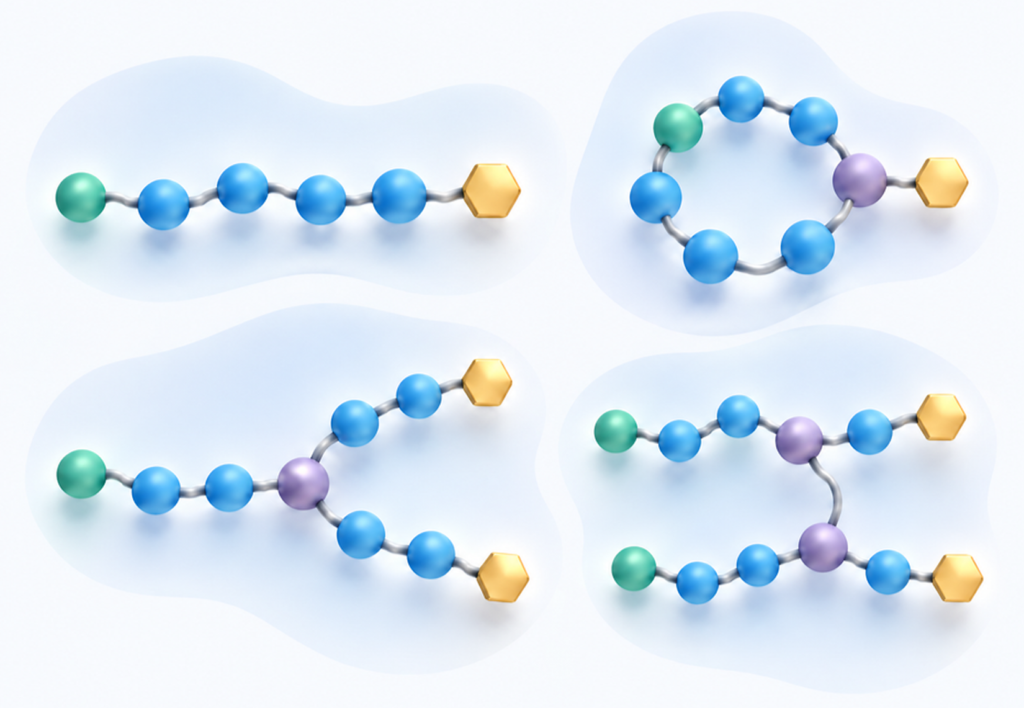
Versatile 3D Synthetic Peptide Architecture Design
Flexible molecular design enables diverse 3D architectures and chemical functionalities tailored to different therapeutic targets.
Our platform integrates amino acids, peptoid residues, and small-molecule components to create structurally diverse and conformationally defined 3D synthetic peptide molecules.
A key element of this platform is the use of peptoid building blocks. Unlike conventional peptides, peptoids carry their side chains on the backbone nitrogen rather than the α-carbon. This distinct structure provides broad flexibility in side-chain chemistry, expands accessible chemical diversity, and offers advantages such as enhanced cell/tissue permeability and resistance to proteolytic degradation.
These diverse building blocks can be further extended by combining peptoid residues with amino acids and small-molecule components. Together, these building blocks can be assembled into linear, cyclic, branched, multimeric, and other conformationally diverse architectures, allowing molecular shape, functional-group presentation, and physicochemical properties to be tuned for different applications.
This modular design strategy enables us to explore a broad chemical and structural space and incorporate desired molecular properties early in the design process for diverse therapeutic targets.
Unique OBTC High-Throughput ‘Hit’ Identification
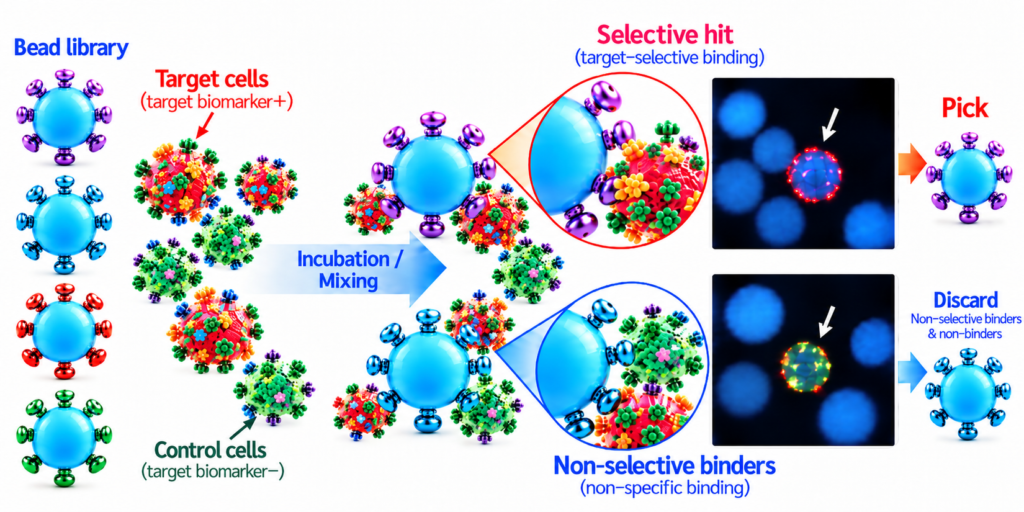
Our proprietary On-Bead Two-Color (OBTC) high-throughput screening technology enables rapid identification of highly selective ‘hit’ compounds for therapeutic targets of interest, while minimizing off-target interactions to reduce side effects.
Our platform uses highly diverse one-bead-one-compound libraries, where each bead represents a distinct molecular candidate with lot of copies displayed. This format enables rapid and efficient screening of large and chemically diverse libraries.
OBTC screening technology is designed to identify compounds that preferentially interact with the desired cellular target/phenotype while simultaneously avoiding interactions with non-target cells. This allows selectivity to be contemplated from the earliest stage of the ‘hit’ discovery, minimizing off-target effects and associated side effects.
The platform can be applied to both known and unknown targets. For known targets, screening can be directed toward selective binders. When the molecular target is not yet known, identified ‘hits’ can also support downstream target identification, providing a route from phenotypic screening to molecular target discovery.
Together, these capabilities provide a flexible discovery strategy across diverse therapeutic targets and disease phenotypes.
Access to Challenging Targets
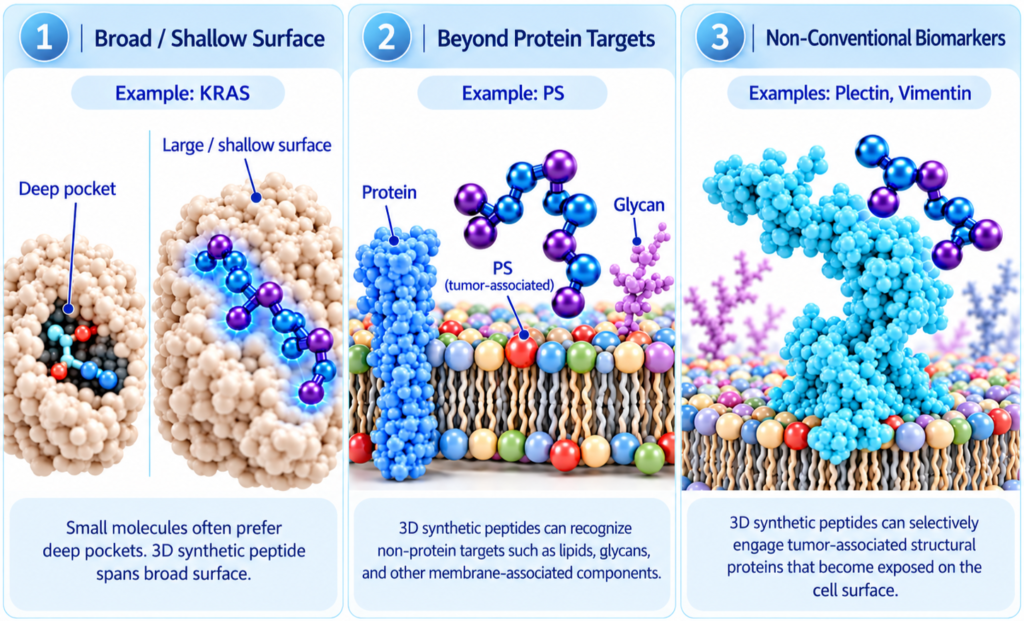
Our platform enables the design of structurally defined molecules capable of engaging diverse target classes, including shallow protein surfaces, tumor-associated lipids, and unconventional cell-surface drug-targets such as structural proteins.
Many conventional therapeutic approaches capable of targeting well-defined binding pockets or established functional sites, leaving other biologically important targets more difficult to address.
Our 3D synthetic peptide platform can incorporate variety of functional groups within a single molecular architecture, enabling 3D multivalent interactions across broad or shallow target surfaces. This creates opportunities to directly engage in challenging proteins such as KRAS, plectin and vimentin where suitable small-molecule binding sites may be limited.
The platform can also be adapted to recognize chemically and biologically diverse tumor-associated features beyond conventional protein targets. For example, we have developed approaches targeting phosphatidylserine (PS), a membrane-associated lipid, as well as non-conventional cell-surface biomarkers such as plectin and vimentin.
Addressing Drug Resistance
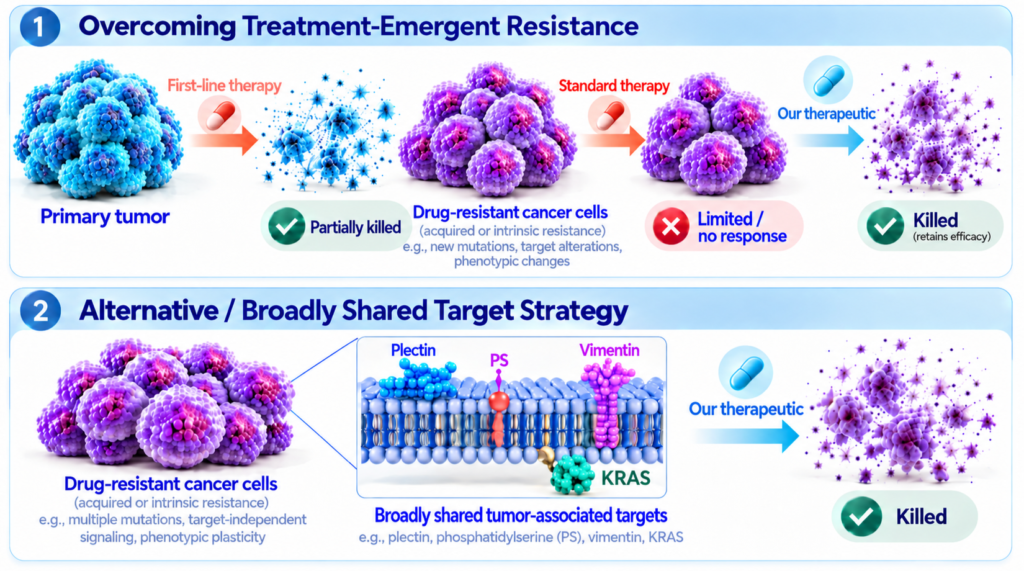
Our platform supports multiple strategies to address drug resistance, including mutation-agnostic targeting, alternative tumor-associated targets, and discovery directly in resistant disease states.
Drug resistance can arise through multiple routes, including resistance that develops during treatment as well as resistance that is already present within the disease. Our platform provides different strategies depending on the underlying biology.
Treatment-emergent resistance can arise when tumors acquire new mutations or target changes that reduce sensitivity to existing therapies. Our platform enables mutation-agnostic and broader targeting strategies designed to remain effective across evolving variants.
Resistance can also be approached through alternative or broadly shared tumor-associated targets, rather than continuing to rely on the original drug target. Targets such as plectin, phosphatidylserine (PS), and vimentin illustrate how the platform can access distinct cancer-associated features that may provide alternative therapeutic entry points.
For intrinsic or phenotype-associated resistance, our platform can support therapeutic strategies designed to remain active across diverse cancer phenotypes and cellular states, rather than relying on a single drug-sensitive state.
By combining molecular design flexibility with selective ‘hit’ identification, our platform can address resistance through different therapeutic routes without being confined to the target, mutation, or mechanism addressed by the original therapy.
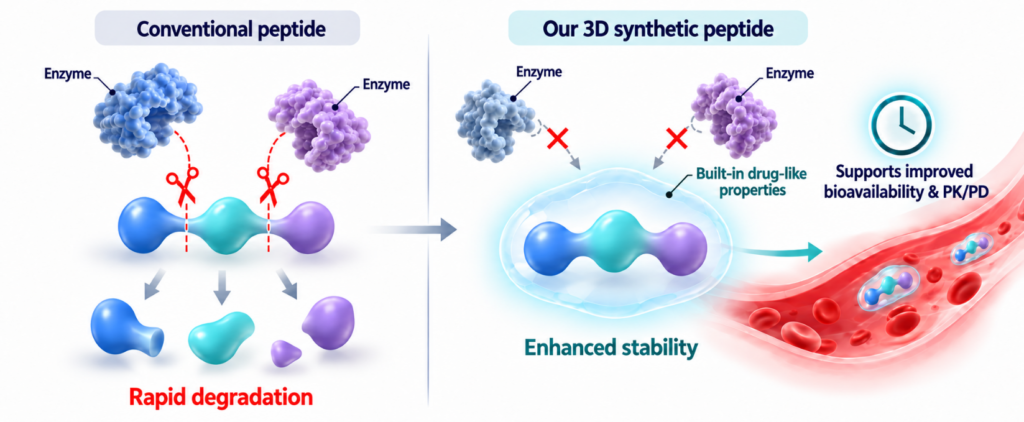
Stability & Bioavailability Optimization
Specialized building blocks and structural features enable drug-like properties to be automatically built into the molecular design, supporting enhanced stability, cell/tissue permeability, bioavailability, and favorable PK/PD properties.
Molecular stability is a major challenge for peptide-based therapeutics, which can be rapidly degraded by proteolytic enzymes. Our platform incorporates peptoid residues, non-natural building blocks, and tailored structural features to reduce susceptibility to enzymatic breakdown and support improved molecular stability.
Importantly, properties such as in vivo stability, cell/tissue permeability, and bioavailability are designed into candidates from the outset, rather than relying primarily on extensive modification after ‘hit’ discovery. This built-in design approach can reduce downstream optimization requirements, time, and development costs while helping preserve therapeutic activity.
Together, these capabilities support the rapid and low-cost development of therapeutic candidates as compared to conventional peptide candidates needing high-cost and time consuming optimizations.